Waste tyres are often viewed as difficult-to-manage waste materials. However, modern recycling technologies can transform end-of-life tyres into valuable resources.
One of the technologies enabling this transformation is tyre pyrolysis.
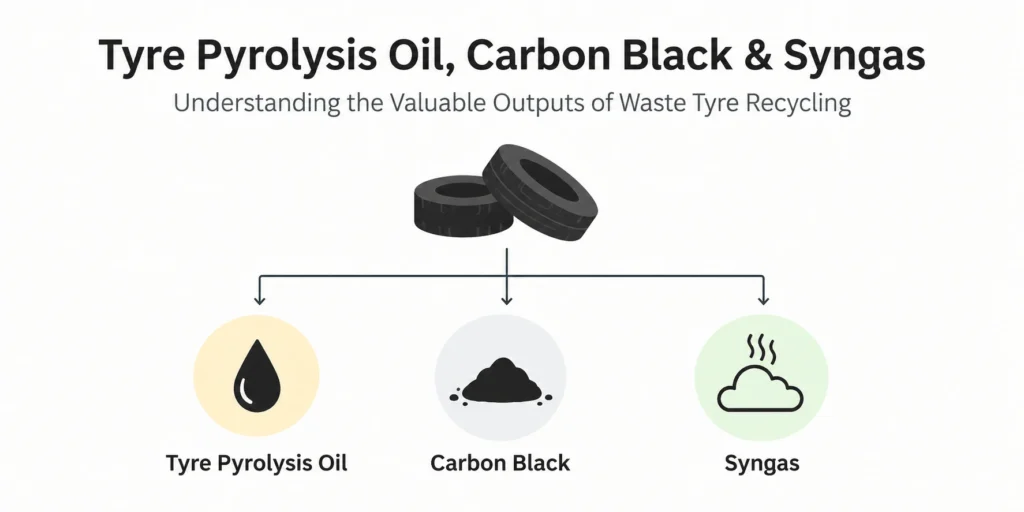
Through controlled thermal decomposition, a tyre pyrolysis plant can recover several products from waste tyres, including Tyre Pyrolysis Oil (TPO), carbon char or recovered carbon black, syngas and steel.
Pyro System’s continuous pyrolysis technology is designed to recover these resources through an automated industrial process. Its website identifies pyrolysis oil, char/carbon black and syngas as key outputs and indicates approximate output ranges of 40–45% oil, 30–35% char and 10–15% syngas, depending on feedstock and operating conditions.
Understanding these outputs is important for anyone considering a tyre pyrolysis plant, because the economics of a recycling project depend not only on waste processing but also on how effectively the recovered products can be handled, refined and sold.
What Happens to a Waste Tyre During Pyrolysis?
A waste tyre contains several valuable components, including rubber, carbon-based materials, additives and steel reinforcement.
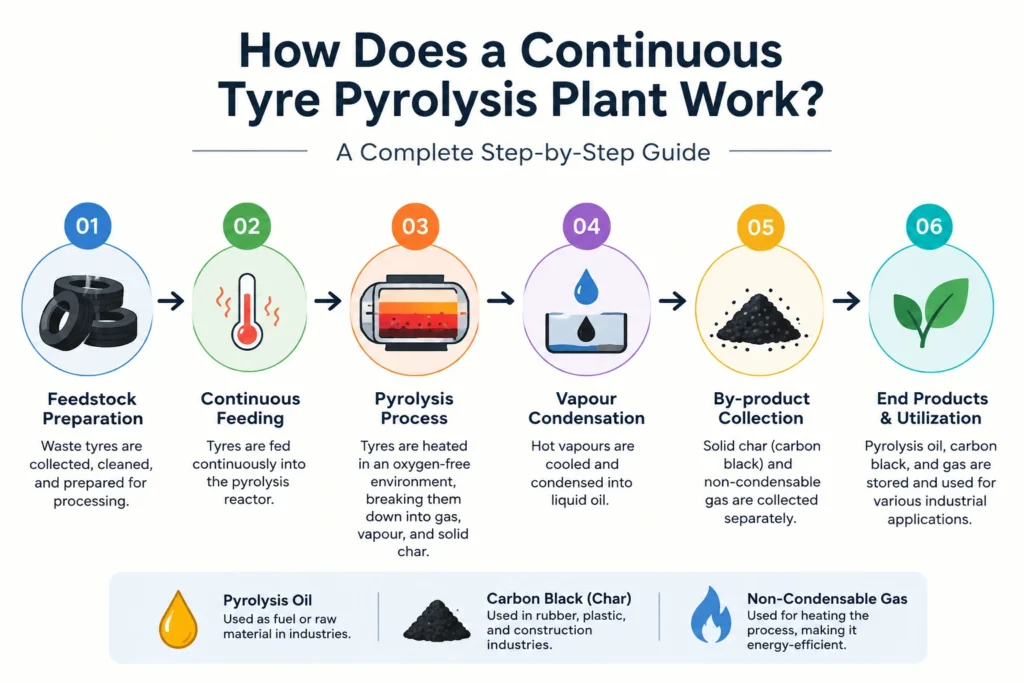
During pyrolysis, prepared tyre material is heated under controlled oxygen-free conditions.
Instead of burning the tyre, the process breaks down its organic components into vapours, gases and solid carbon-rich material.
These streams can then be separated and collected.
The result is a multi-output recycling process.
Instead of treating the waste tyre as one material, pyrolysis separates it into different resource streams.
The main outputs are:
- Tyre Pyrolysis Oil
- Carbon Char
- Recovered Carbon Black
- Syngas
- Recovered Steel
Let’s look at each one in detail.
1. Tyre Pyrolysis Oil
Tyre Pyrolysis Oil, commonly called TPO, is one of the most commercially important products generated during tyre pyrolysis.
It is produced when hydrocarbon vapours generated during thermal decomposition are cooled and condensed.
Pyro System indicates an oil recovery range of approximately 40–45% for its continuous tyre pyrolysis process.
However, the actual output can vary according to:
- Tyre composition
- Feedstock preparation
- Reactor conditions
- Temperature
- Residence time
- Condensation efficiency
- Process configuration
Therefore, published percentages should be treated as indicative rather than universal.
How Is Tyre Pyrolysis Oil Used?
TPO can have applications as a waste-derived industrial fuel, subject to its characteristics and applicable regulations.
A recent analysis of waste tyre circularity in India notes potential use of TPO as industrial heating oil in applications such as boilers, furnaces and kilns. It also notes that further refining can expand its potential applications.
This creates an opportunity for industries that require thermal energy.
However, businesses should not assume that raw TPO can automatically replace every conventional fuel.
Its suitability depends on:
- Fuel properties
- Quality specifications
- Refining level
- Equipment compatibility
- Applicable standards
- Regulatory requirements
TPO Refining
Pyrolysis oil can be further processed depending on the intended application.
Pyro System describes an integrated refining approach in which oil can be processed through a distillation plant to produce higher-grade industrial fuel.
Refining can potentially improve the consistency and usability of the recovered oil.
For investors, this is important because the value of the output may depend on whether the plant simply produces raw pyrolysis oil or includes additional downstream processing.
2. Carbon Char
The second major output is carbon char.
During pyrolysis, a portion of the tyre does not convert into vapour or gas.
Instead, a carbon-rich solid material remains.
This material is commonly referred to as char.
Pyro System’s process includes a carbon discharge silo for collecting the solid carbon output.
Carbon char can have value as an industrial material or as a feedstock for further processing.
However, raw char and high-quality recovered carbon black should not automatically be considered the same product.
What Is Recovered Carbon Black?
Recovered Carbon Black (rCB) is produced by processing carbon-rich material recovered from end-of-life tyres.
The quality of rCB depends on factors such as:
- Feedstock
- Pyrolysis conditions
- Ash content
- Surface properties
- Post-treatment
- Particle characteristics
Recent Indian circular-economy research notes that processed rCB can be used as a reinforcing filler in rubber products, while higher-quality rCB can replace part of virgin carbon black in selected tyre applications.
This is an important development for the tyre and rubber industries.
Why Is rCB Important?
Virgin carbon black is an important industrial material used in rubber and other products.
Recovering carbon from end-of-life tyres creates an opportunity to return carbon-based material back into manufacturing.
This supports the principles of a circular economy.
Instead of extracting new raw materials for every production cycle, recycling technologies attempt to recover and reuse existing resources.
For tyre manufacturers and rubber product companies, recovered carbon black can therefore become an important secondary raw material when its specifications meet the requirements of the intended application.
3. Syngas
The third important output is syngas or non-condensable gas.
Not every hydrocarbon vapour produced during pyrolysis becomes liquid oil.
Some gases remain non-condensable under the operating conditions.
These gases can be recovered as a combustible process gas.
Pyro System identifies syngas as one of the main outputs of its continuous tyre pyrolysis technology.
How Is Syngas Used?
One of the major benefits of recovering pyrolysis gas is the possibility of using it as an energy source.
Research on waste tyre pyrolysis indicates that syngas can potentially be used to power the pyrolysis process itself, improving energy integration.
This can reduce the need for external fuel, depending on plant design and operating conditions.
The concept is relatively simple:
Waste tyre → Pyrolysis → Gas recovery → Energy generation → Process heating
This creates a partial closed-loop energy system.
4. Recovered Steel
Waste tyres contain steel wires that provide structural reinforcement.
During pyrolysis, the rubber and other organic components decompose while the steel remains.
The steel can therefore be recovered after processing.
Recovered steel is typically separated and sent for further recycling.
This creates another revenue or resource-recovery stream from the same waste tyre.
Therefore, the overall value proposition of a tyre pyrolysis plant should not be calculated only from oil production.
A better approach is to evaluate the combined value of:
Oil + Carbon + Gas + Steel
Understanding Pyrolysis Output Percentages
One of the most common questions from potential investors is:
How much product can a tyre pyrolysis plant produce?
There is no single percentage that applies to every plant.
Output depends on multiple variables.
These include:
Feedstock Composition
Different tyre types contain different proportions of rubber, carbon, steel and additives.
Reactor Technology
The reactor design affects heat transfer and material residence time.
Operating Conditions
Temperature and processing conditions influence the breakdown of the feedstock.
Condensation Efficiency
Efficient condensation affects the amount of recoverable liquid.
Post-Processing
Further processing can alter the final product quantities and quality.
Pyro System lists indicative output ranges of:
- Pyrolysis Oil: 40–45%
- Char/Carbon Black: 30–35%
- Syngas: 10–15%
Actual output should be determined through technical evaluation and feedstock testing.
Why Product Quality Matters
Production quantity is only one part of the equation.
Product quality can be equally important.
For example, producing more carbon char does not necessarily mean producing more valuable recovered carbon black.
Similarly, producing pyrolysis oil does not automatically mean that the oil is suitable for every industrial fuel application.
Therefore, a commercial pyrolysis operation should focus on:
Yield + Quality + Consistency + Marketability
Applications of Pyrolysis Oil
Depending on specifications and regulatory requirements, TPO can potentially be used in industrial heating applications.
Potential users can include industries operating:
- Boilers
- Furnaces
- Kilns
- Thermal heating systems
Research compiled for India’s waste tyre circular economy identifies TPO as a potential industrial heating oil and discusses additional opportunities after refining.
The key consideration is matching product specifications to end-user requirements.
Applications of Recovered Carbon Black
Recovered carbon black can potentially be used in:
- Rubber products
- Moulded rubber products
- Floor mats
- Selected footwear applications
- Tyre components
- Industrial rubber products
The final application depends heavily on the grade and quality of the recovered carbon black.
Higher-quality rCB can potentially replace a portion of virgin carbon black in selected applications, helping reduce dependence on virgin materials.
Applications of Syngas
Syngas is particularly valuable because it can potentially be reused within the plant.
Instead of treating process gas as an unwanted by-product, an integrated plant can recover it and use it as a fuel source.
This can improve energy efficiency.
A well-engineered system therefore aims to maximise resource recovery from the entire feedstock.
Applications of Recovered Steel
Recovered steel can be sold as scrap and sent to metal recycling facilities.
The steel may subsequently enter other manufacturing processes.
This adds another circular-economy benefit to tyre pyrolysis.
Tyre Pyrolysis and the Circular Economy
The circular economy aims to keep materials and resources in productive use for as long as possible.
Traditional linear models follow:
Take → Make → Use → Dispose
A recycling-based model aims to move toward:
Waste → Recovery → Processing → Reuse
Tyre pyrolysis supports this concept by recovering multiple materials from a waste product.
The recovered outputs can potentially return to different industrial value chains.
According to NITI Aayog’s recent analysis of India’s waste tyre circular economy, pyrolysis can recover carbon char, TPO and steel, with further processing creating additional opportunities for recovered carbon black and refined products.
The Importance of Downstream Processing
A modern tyre pyrolysis project should not stop at the reactor.
Downstream processing can determine the commercial value of the recovered materials.
For example:
Raw char → Processing → Recovered Carbon Black
Raw pyrolysis oil → Distillation → Higher-grade industrial fuel
This is why integrated recycling systems can offer greater opportunities than standalone thermal processing.
Pyro System describes downstream refining capabilities involving oil distillation and rCB processing.
Is Tyre Pyrolysis a Zero-Waste Process?
It is better to describe pyrolysis as a resource recovery technology rather than assume that every plant achieves literally zero waste under every operating condition.
A well-designed plant can recover multiple valuable fractions and minimise residual waste.
However, environmental performance depends on:
- Plant design
- Pollution control
- Feedstock quality
- Operating conditions
- Residue management
- Regulatory compliance
The goal should therefore be maximum resource recovery with environmentally responsible operation.
Regulatory Considerations in India
Businesses planning to establish tyre pyrolysis facilities in India should pay close attention to environmental regulations.
CPCB’s waste tyre framework regulates waste tyre management under the Hazardous and Other Wastes framework, including EPR requirements.
CPCB’s SOP for tyre pyrolysis also includes requirements concerning plant operation, registration, product handling, waste tyre sourcing, reporting and environmental safeguards.
Therefore, compliance should be considered from the project-planning stage rather than after installation.
Conclusion
The value of tyre pyrolysis lies in its ability to convert one difficult waste stream into multiple useful resource streams.
The main outputs are:
Tyre Pyrolysis Oil → Industrial fuel applications
Carbon Char → Potential feedstock for recovered carbon black
Syngas → Potential process energy
Steel → Metal recycling
For a modern continuous tyre pyrolysis plant, the objective is not simply to process waste tyres faster.
The bigger opportunity is to improve resource recovery, automation, energy utilisation, product quality and environmental performance.
As waste tyre management becomes increasingly structured in India, technologies that can recover materials and return them to productive use can contribute to a more circular industrial economy.
For businesses evaluating a tyre pyrolysis machine, understanding the output streams and their potential markets is just as important as evaluating reactor capacity.
The strongest projects are built around the complete value chain:
Feedstock → Pyrolysis → Separation → Refining → Product Quality → Market
Frequently Asked Questions
The main products are tyre pyrolysis oil, carbon char, syngas and recovered steel.
Recovered carbon black is a processed carbon-rich material obtained from end-of-life tyres and used in selected rubber and industrial applications.
Pyro System indicates an oil output of approximately 40–45%, although actual yield varies according to feedstock and operating conditions.
Steel reinforcement remains after the organic material undergoes pyrolysis and can be separated and sent for metal recycling.