Waste tyre management has become an increasingly important industrial and environmental challenge. Every year, large quantities of end-of-life tyres require responsible collection, processing and recycling. Conventional disposal methods such as landfilling and uncontrolled burning can create environmental concerns, while simply storing waste tyres consumes valuable space and creates long-term waste management challenges.
One technology gaining attention in industrial recycling is tyre pyrolysis.
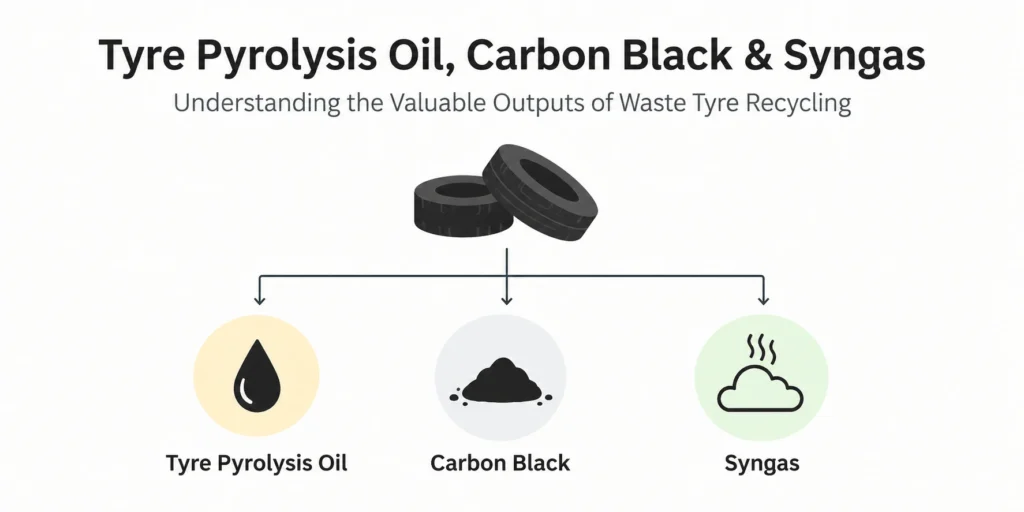
A modern continuous tyre pyrolysis plant is designed to process waste tyres continuously under controlled, oxygen-free conditions and convert them into valuable products such as Tyre Pyrolysis Oil (TPO), carbon char, syngas and recovered steel.
Pyro System, a sustainable technology initiative of Prosper Group, develops automated continuous pyrolysis systems designed for large-scale industrial resource recovery. Its system is designed around controlled feeding, continuous processing, gas condensation, carbon collection and process monitoring.
But how exactly does a continuous tyre pyrolysis machine work?
Let’s understand the complete process step by step.
What Is Tyre Pyrolysis?
Tyre pyrolysis is a thermal decomposition process in which waste tyres are heated at controlled temperatures in an environment with little or no oxygen.
Unlike combustion, where material is burned in the presence of oxygen, pyrolysis thermally decomposes the tyre material without directly burning it.
Waste tyres primarily contain rubber, carbon-based materials, additives and steel reinforcement. When subjected to controlled thermal conditions, these components break down and produce different fractions.
The main outputs generally include:
- Tyre Pyrolysis Oil
- Carbon Char
- Syngas
- Recovered Steel
The exact output depends on factors such as feedstock composition, operating conditions, reactor design and downstream processing.
According to Pyro System, its continuous tyre pyrolysis technology can convert waste tyres into approximately 40–45% pyrolysis oil, 30–35% char/carbon black and 10–15% syngas, depending on operating conditions and feedstock.
What Is a Continuous Tyre Pyrolysis Plant?
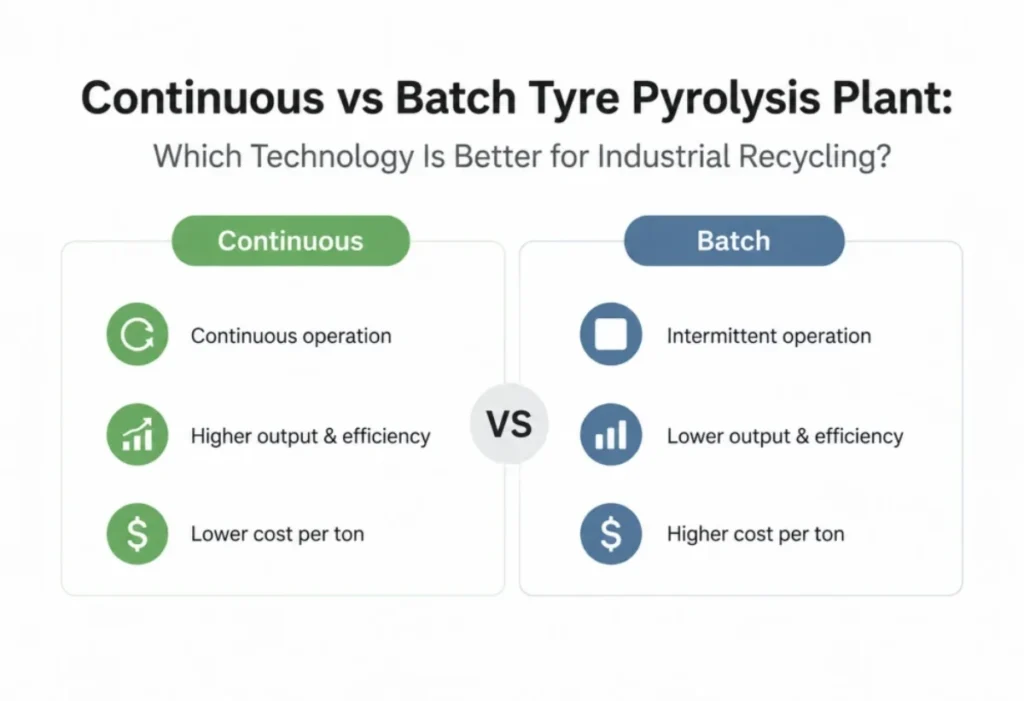
A continuous tyre pyrolysis plant is an automated recycling system designed to feed, process and discharge material continuously instead of stopping the reactor after every batch.
In a batch pyrolysis system, the reactor is loaded, processed, cooled and unloaded before the next cycle begins.
A continuous system is designed to maintain a steady flow of feedstock and products.
This can offer several advantages for industrial operations, including:
- Continuous production
- Better process automation
- Reduced manual handling
- Consistent feeding
- Reduced downtime between cycles
- Better integration with monitoring systems
- Potentially improved energy utilisation
Pyro System highlights features such as automated PLC and SCADA control, continuous 24-hour industrial production, dual hopper feeding, negative-pressure operation and an internal auger-type screw reactor design.
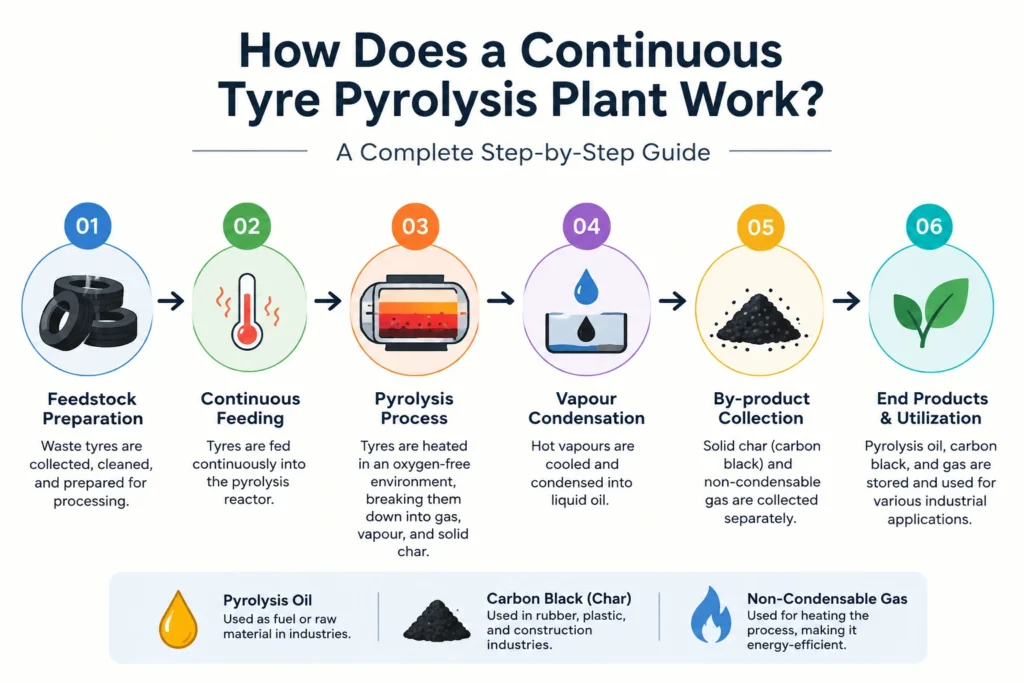
Step 1: Waste Tyre Collection and Preparation
The process starts with the raw material.
Waste tyres are collected and prepared for processing. Depending on the plant configuration, tyres may undergo preliminary preparation such as removal of unwanted materials, size reduction or cutting into suitable pieces.
Proper feedstock preparation is important because the consistency of the raw material can affect feeding, heat transfer and overall process stability.
For tyre pyrolysis, the feedstock commonly consists of end-of-life tyres generated from vehicles and industrial applications.
The prepared rubber material is then transported toward the feeding section of the plant.
Step 2: Feeding Silo
The prepared material is stored temporarily in the feeding silo.
The feeding silo serves as an intermediate storage point between raw material preparation and the reactor.
A continuous plant needs a stable and controlled material supply. The feeding system therefore plays an important role in maintaining uninterrupted operation.
Pyro System’s system includes a feeding silo for storing raw material before it enters the processing system.
Step 3: Controlled Feeding Through the Weighing Hopper
The material then passes through a controlled feeding mechanism.
The weighing hopper helps regulate the quantity of material entering the process.
Controlled feeding is essential because an inconsistent feed rate can affect:
- Reactor temperature
- Residence time
- Heat distribution
- Product yield
- Process stability
In an automated system, sensors and control systems can monitor and regulate the feeding process.
This is one of the major differences between a highly automated industrial pyrolysis plant and a manually operated system.
Step 4: Z-Bucket Elevator and Material Transfer
A Z-bucket elevator can be used to transfer the prepared material between different levels of the plant.
Its purpose is to provide controlled vertical transportation while maintaining a continuous material flow.
Material handling may appear like a small part of the overall process, but it becomes increasingly important as plant capacity increases.
A reliable material transfer system helps reduce interruptions and manual handling.
Step 5: Reactor / Cracking System
The prepared feedstock eventually enters the heart of the plant: the reactor.
This is where the actual pyrolysis process takes place.
Inside the reactor, the waste tyre material is subjected to controlled thermal conditions in an oxygen-free or oxygen-limited environment.
As the temperature increases, the rubber and other organic components undergo thermal decomposition.
The process generates:
- Vapour
- Non-condensable gases
- Solid carbon-rich material
- Steel, where applicable
The reactor design plays a critical role in determining heat transfer, material residence time and overall process efficiency.
Pyro System describes its reactor as using an internal auger-type screw design and controlled thermal processing for continuous operation.
Step 6: Vapour and Gas Movement
As the feedstock undergoes thermal decomposition, vapours and gases are generated.
These products must then be separated and processed.
The vapour stream can be routed toward condensation systems, while non-condensable gases can be separated and managed for energy recovery or other applications.
Efficient vapour handling is important because uncontrolled vapour movement can negatively affect both process efficiency and safety.
Step 7: Catalytic Chamber
Pyro System’s process incorporates a catalytic chamber for gas treatment and separation.
The catalytic stage can help refine and process generated gases before downstream condensation or utilisation.
Catalytic processing is particularly important in advanced pyrolysis systems where the objective is not simply to thermally decompose waste but to improve the quality and usability of recovered products.
Step 8: Condensation and Pyrolysis Oil Recovery
The hot vapours generated during pyrolysis are directed toward the condensation system.
As the vapours cool, condensable hydrocarbons turn into liquid.
This liquid is collected as Tyre Pyrolysis Oil (TPO).
TPO is one of the major commercial outputs of waste tyre pyrolysis.
Its potential applications depend on its characteristics, treatment and applicable regulations. Research and industry studies identify applications such as industrial heating fuel, while further refining can expand potential uses.
Pyro System states that its tyre pyrolysis process can produce approximately 40–45% pyrolysis oil, depending on the feedstock and process conditions.
Step 9: Syngas Recovery
Not all vapours condense into liquid.
The remaining non-condensable gases form a combustible gas stream commonly referred to as syngas or pyro gas.
Rather than treating this gas only as a waste stream, modern pyrolysis systems can recover and reuse process gas as an energy source.
Pyro System lists syngas among the main outputs of its continuous pyrolysis technology.
Research on tyre recycling also identifies non-condensable gases as a potential energy source for powering the pyrolysis process itself, depending on system design and operating conditions.
This creates an important opportunity for energy integration.
Step 10: Carbon Char Collection
Another major output is solid carbon-rich material.
After thermal decomposition, the remaining solid fraction is collected through the carbon discharge silo.
Pyro System describes its system as collecting solid carbon/char through a dedicated discharge silo.
The material can potentially be further processed into Recovered Carbon Black (rCB).
The quality and final application of recovered carbon depend on feedstock, pyrolysis conditions and post-processing.
According to recent research and industry analysis, processed rCB can be used in applications including rubber products and, depending on quality, as a partial substitute for virgin carbon black in certain tyre applications.
Step 11: Steel Recovery
Waste tyres contain steel reinforcement.
During pyrolysis, the organic components are thermally decomposed while steel remains as a solid material.
The recovered steel can be separated from the solid output and sent for recycling.
This adds another material recovery stream to the overall process.
Therefore, tyre pyrolysis is not simply about producing oil.
It can potentially recover multiple resources from a single waste stream.
Step 12: Dust and Emission Control
Environmental control is a critical part of any industrial pyrolysis plant.
Pyro System includes a D-Dusting Tank designed to remove dust and impurities from the relevant gas stream.
The plant also highlights controlled emissions, negative-pressure operation and environmental compliance support.
In India, tyre pyrolysis operations are subject to regulatory requirements. CPCB’s waste tyre framework and SOPs include specific conditions for tyre pyrolysis units, including environmental safeguards, reporting and operational requirements.
Therefore, businesses evaluating a pyrolysis plant should consider not only production capacity but also pollution-control systems, approvals and compliance requirements.
Why Is Continuous Pyrolysis Important?
Continuous pyrolysis technology is particularly relevant for industrial-scale recycling.
Instead of processing one batch and stopping the reactor for unloading and reloading, a continuous system is designed around uninterrupted material movement.
Potential advantages include:
1. Higher operational continuity
Continuous feeding and discharge can support long operating cycles.
2. Lower manual intervention
Automated feeding and discharge can reduce labour requirements.
3. Process monitoring
PLC and SCADA systems allow operators to monitor important process parameters.
4. Better energy integration
Recovered process gas can potentially be reused within the plant.
5. Scalability
Continuous technology is suited to businesses looking for industrial-scale waste processing.
What Materials Can Pyrolysis Plants Process?
Although tyre pyrolysis is one of the best-known applications, advanced pyrolysis technology can be designed for several feedstocks.
Pyro System lists:
- Waste tyres
- Rubber waste
- Plastic waste
- Municipal sludge
- Scrap cables
- Oil sludge
- Biomass
- Municipal solid waste
as potential feedstocks for its systems.
However, the appropriate reactor configuration and operating conditions can vary depending on the feedstock.
Is a Continuous Tyre Pyrolysis Plant Environmentally Friendly?
The environmental performance of a pyrolysis plant depends heavily on plant design, operation, feedstock handling and pollution-control infrastructure.
A properly designed system can contribute to resource recovery by diverting waste tyres from disposal and converting them into useful materials.
India’s current regulatory framework specifically addresses environmentally sound waste tyre management, including Extended Producer Responsibility and operational requirements for recycling facilities.
It is therefore important to avoid viewing pyrolysis as simply a machine purchase.
A responsible project should consider:
- Feedstock sourcing
- Plant location
- Environmental permissions
- Pollution-control systems
- Product quality
- Product buyers
- EPR requirements
- Worker safety
- Fire protection
- Waste handling
Choosing a Continuous Tyre Pyrolysis Plant
Before investing in a continuous pyrolysis machine, businesses should evaluate several factors.
Processing Capacity
Determine how many tonnes of waste tyre the plant needs to process per day.
Reactor Technology
Understand the reactor design, heat transfer system and material movement mechanism.
Automation
Look for PLC and SCADA-based monitoring where appropriate.
Safety
Evaluate pressure management, explosion protection, fire safety and emergency shutdown systems.
Product Quality
Ask for technical specifications and expected quality of pyrolysis oil, char, gas and recovered steel.
Environmental Compliance
Check whether the plant design supports applicable CPCB/SPCB requirements.
After-Sales Support
Installation, commissioning, training, maintenance and technical support are important for long-term plant performance.
Pyro System highlights services including plant design and layout, installation and commissioning, certification support, EPR registration assistance and ongoing technical support.
Conclusion
A continuous tyre pyrolysis plant is more than a waste processing machine. It is an integrated resource recovery system designed to convert end-of-life tyres into useful products such as Tyre Pyrolysis Oil, carbon char, syngas and recovered steel.
The process begins with feedstock preparation and controlled feeding, continues through the reactor and condensation stages, and ends with the recovery and processing of multiple valuable outputs.
For industrial recyclers, manufacturers and investors, the major opportunity lies in combining continuous production, automation, energy recovery and responsible environmental management.
As India moves toward a stronger circular economy and more structured waste tyre management, advanced recycling technologies can play an important role in converting difficult waste streams into valuable industrial resources. CPCB’s current framework also places increasing emphasis on authorised recycling and EPR-based waste tyre management.
For businesses considering a continuous tyre pyrolysis machine, the right approach is to evaluate technology, capacity, feedstock, product markets, environmental compliance and long-term operational support together.
Frequently Asked Questions
Pyro System states an indicative pyrolysis oil output of approximately 40–45% for its system, with actual performance depending on feedstock and operating conditions.
Recovered Carbon Black, or rCB, is carbon-rich material recovered from waste tyre pyrolysis and further processed for use in selected rubber and industrial applications.
Yes. Non-condensable process gas can potentially be recovered and used as an energy source within a suitably designed pyrolysis system.
Tyre pyrolysis is subject to applicable environmental and waste-management regulations. Operators must comply with relevant CPCB/SPCB requirements, registrations, permissions and operational conditions.
Yes. Depending on plant design, pyrolysis systems can be developed for materials such as rubber, plastics, oil sludge, biomass and other feedstocks.
Continuous systems are designed for ongoing feeding and discharge, potentially reducing downtime and manual intervention and making them suitable for industrial-scale operations.