Choosing the right pyrolysis technology is one of the most important decisions for anyone planning a waste tyre recycling project.
Two major approaches are commonly discussed:
- Batch tyre pyrolysis
- Continuous tyre pyrolysis
Both technologies use thermal decomposition to process waste tyres, but their operating models are different.
A batch pyrolysis plant processes a defined quantity of feedstock at a time, while a continuous pyrolysis plant is designed to maintain a continuous flow of feedstock and product discharge.
For small operations, batch processing may have certain practical advantages. For large-scale industrial recycling, continuous technology can offer significant benefits related to automation, production continuity, labour requirements and process integration.
Pyro System focuses on automated continuous pyrolysis technology designed for industrial-scale recycling. Its system includes automated PLC and SCADA controls, continuous production, controlled feeding and discharge, negative-pressure operation and an internal auger-type reactor design.
So, which technology is better?
The answer depends on the project’s capacity, feedstock, investment strategy and operating requirements.
Let’s compare them in detail.
What Is a Batch Pyrolysis Plant?
A batch pyrolysis plant processes material in individual batches.
The general cycle is:
Loading → Heating → Pyrolysis → Cooling → Unloading → Reloading
The reactor must generally complete a cycle before the next batch begins.
This operating model can be relatively straightforward and may be suitable for certain smaller or flexible applications.
However, the repeated loading, heating, cooling and unloading stages create downtime between production cycles.
What Is a Continuous Pyrolysis Plant?
A continuous pyrolysis plant is designed for ongoing processing.
Instead of waiting for one complete batch to finish before loading the next, feedstock is continuously introduced into the reactor while processed material is continuously discharged.
The general concept is:
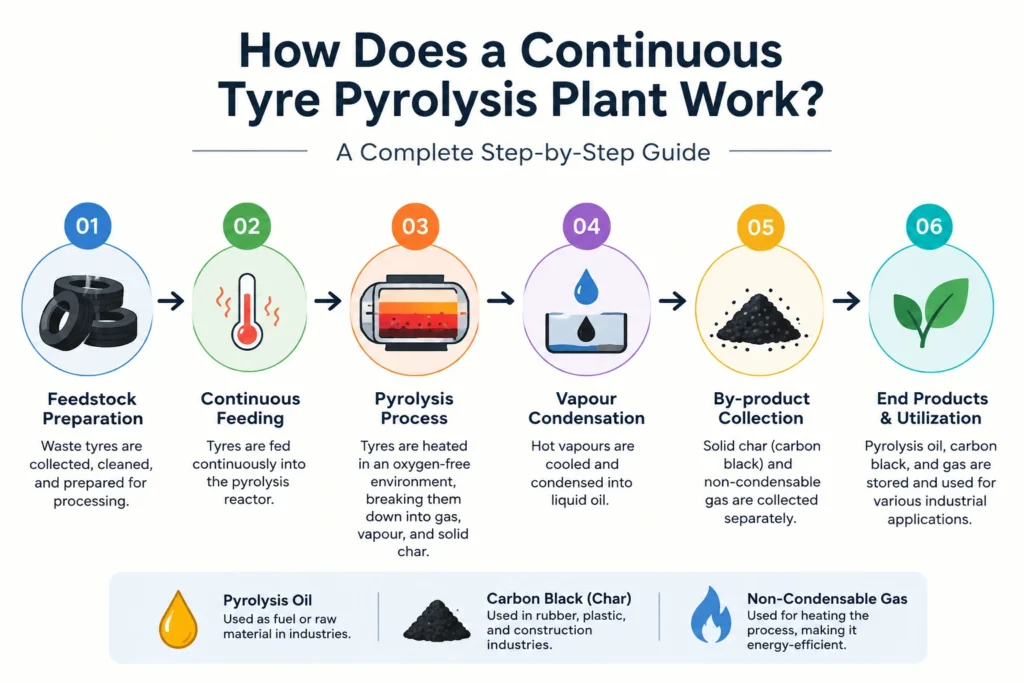
Continuous Feeding → Continuous Pyrolysis → Continuous Separation → Continuous Discharge
This makes continuous technology particularly relevant to industrial recycling facilities that need long operating cycles.
Pyro System specifically highlights continuous 24-hour industrial production as one of its technology features.
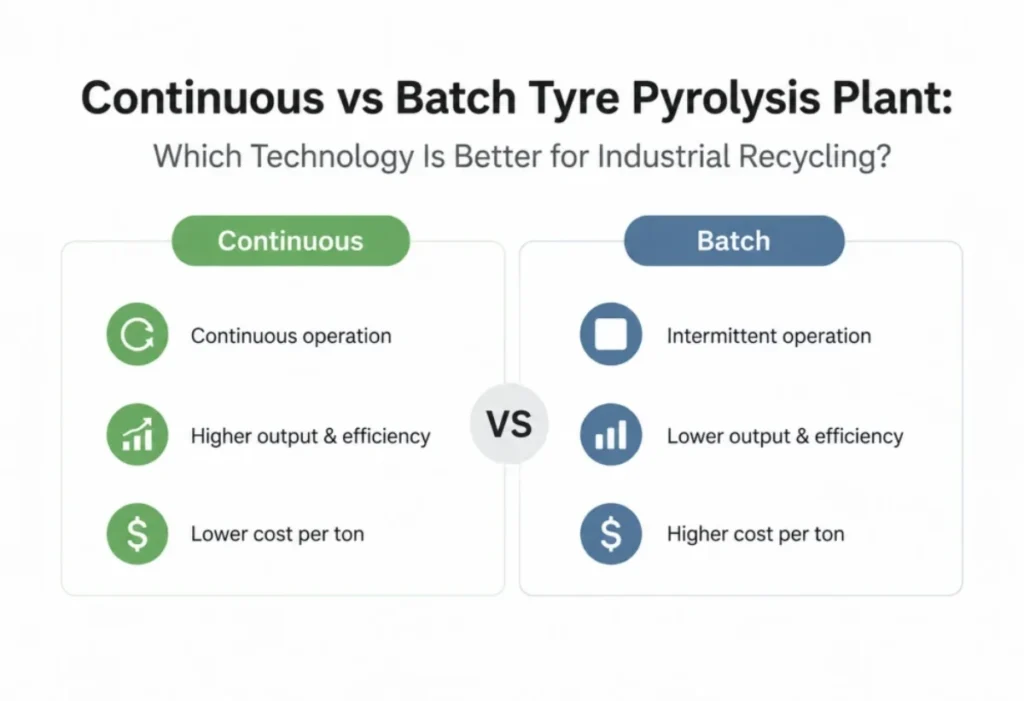
Continuous vs Batch: Basic Comparison
Feature | Batch Pyrolysis | Continuous Pyrolysis |
Feeding | Batch-wise | Continuous |
Product discharge | Batch-wise | Continuous |
Downtime | Higher between cycles | Lower between production cycles |
Automation | Can vary | Typically higher in advanced systems |
Labour requirement | Potentially higher | Potentially lower |
Industrial-scale production | Suitable in selected cases | Strong fit |
Process monitoring | Depends on system | PLC/SCADA integration possible |
Energy integration | Depends on design | Strong potential |
Production continuity | Interrupted by cycles | Designed for continuous operation |
1. Production Continuity
One of the biggest differences is production continuity.
In a batch system, the plant goes through repeated production cycles.
The reactor must eventually stop for cooling, unloading and preparation for the next cycle.
A continuous plant is designed to keep material moving through the system.
For industrial recyclers, this can provide a major operational advantage.
Instead of:
Process → Stop → Cool → Unload → Reload → Restart
the process can be designed around:
Feed → Process → Discharge → Repeat continuously
This is particularly valuable when the plant is expected to operate for long periods.
2. Automation
Automation is another major consideration.
A modern continuous pyrolysis plant can integrate:
- PLC control
- SCADA monitoring
- Automated feeding
- Temperature monitoring
- Pressure monitoring
- Gas monitoring
- Automated discharge
- Safety interlocks
Pyro System highlights automated PLC and SCADA control as one of its core technology features.
Automation can reduce manual intervention and allow operators to monitor the process from a central control interface.
3. Labour Requirements
Batch plants can require more manual intervention because operators may need to handle loading and unloading activities between cycles.
A continuous plant can automate several of these functions.
This does not mean that a continuous plant requires no workers.
Operators are still needed for:
- Monitoring
- Maintenance
- Safety
- Quality control
- Feedstock management
- Product handling
However, automation can reduce repetitive manual tasks.
4. Energy Efficiency
Energy utilisation is an important factor in pyrolysis economics.
A batch system may need repeated heating and cooling cycles.
Continuous technology can maintain a more stable process environment.
Recent analysis of waste tyre recycling in India identifies continuous pyrolysis as having potential advantages related to continuous feeding/discharge and lower fuel consumption compared with certain batch configurations, although actual performance depends on plant design and operating conditions.
Another important factor is process gas.
Non-condensable pyrolysis gas can potentially be reused as an energy source.
This creates the possibility of integrating waste-derived gas back into the plant’s energy system.
5. Product Consistency
Industrial buyers often care about product consistency.
For example, customers purchasing pyrolysis oil or recovered carbon materials may require relatively stable product characteristics.
A continuous process can be designed to maintain relatively consistent operating conditions.
However, consistency still depends on:
- Feedstock quality
- Temperature control
- Feed rate
- Reactor design
- Condensation system
- Process monitoring
Therefore, continuous technology does not automatically guarantee consistent product quality; the complete process must be engineered accordingly.
6. Feedstock Management
Feedstock preparation is important for both technologies.
For tyre pyrolysis, waste tyres need to be collected and prepared appropriately before entering the plant.
A continuous plant benefits particularly from consistent feedstock because interruptions in material supply can affect production continuity.
A reliable feedstock supply chain should therefore be established before plant commissioning.
7. Scalability
Businesses planning a large-scale recycling operation should think about future expansion.
A continuous system can be particularly suitable where the objective is to process substantial quantities of waste material over extended operating periods.
Pyro System describes its technology as intended for large-scale recycling systems and industrial resource recovery.
The right capacity should be selected based on:
- Available waste tyres
- Supply contracts
- Product demand
- Land availability
- Investment capital
- Regulatory permissions
- Utilities
- Workforce
- Logistics
8. Safety and Process Control
Safety should be a priority regardless of whether a plant is batch or continuous.
Pyrolysis involves high temperatures, combustible gases and hydrocarbons.
Therefore, industrial systems should incorporate appropriate safety mechanisms.
Pyro System highlights features including:
- Explosion-proof design
- Negative-pressure operation
- Automated controls
- Controlled gas handling
- Safety-oriented process design
CPCB’s SOP for tyre pyrolysis also includes operational safety requirements and provisions concerning worker health, fire drills and insurance for workers, plant, machinery and materials.
Businesses should therefore evaluate safety systems as carefully as production capacity.
9. Environmental Compliance
Environmental compliance is another major difference between simply purchasing equipment and developing a professional recycling facility.
In India, tyre pyrolysis units operate within the waste tyre management and environmental regulatory framework.
CPCB’s current framework requires applicable recyclers and stakeholders to comply with registration, reporting and waste management requirements.
CPCB’s tyre pyrolysis SOP also establishes requirements for continuous and advanced batch automated pyrolysis facilities.
Therefore, environmental infrastructure should be incorporated into plant design from the beginning.
10. Product Recovery
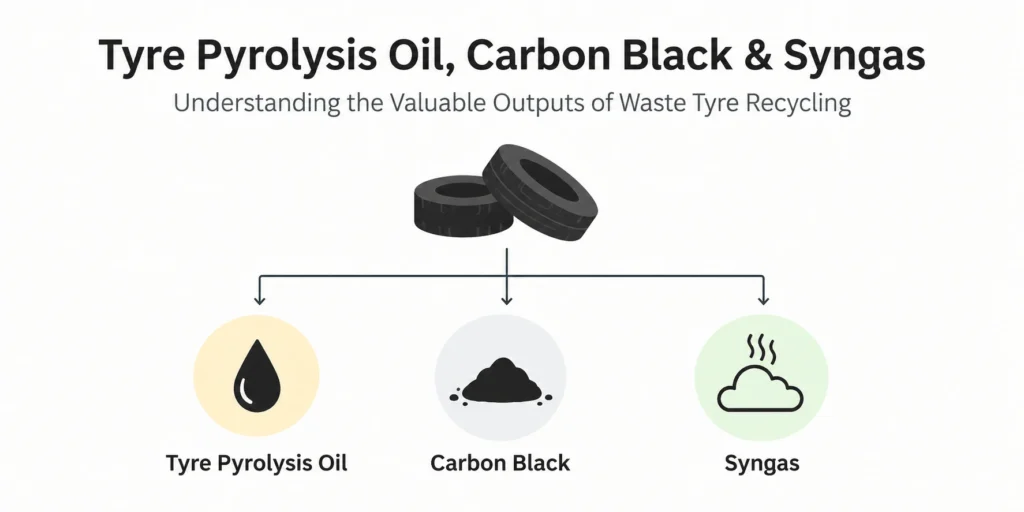
Both batch and continuous systems can recover valuable outputs.
These include:
- Pyrolysis Oil
- Carbon Char
- Syngas
- Steel
The difference is primarily in how the feedstock is processed and how continuously the system operates.
Pyro System’s continuous process is designed around resource recovery, with stated indicative output ranges of 40–45% pyrolysis oil, 30–35% char/carbon black and 10–15% syngas.
11. Maintenance
Every industrial plant requires maintenance.
Batch systems can sometimes be easier to understand operationally because their cycle-based structure is straightforward.
Continuous systems, however, may include more automation, conveyors, feeding equipment, sensors and continuous material-handling components.
This means maintenance planning becomes essential.
A good continuous pyrolysis project should have:
- Preventive maintenance schedules
- Spare parts planning
- Sensor calibration
- Electrical maintenance
- Mechanical inspection
- Reactor inspection
- Pump maintenance
- Condenser cleaning
- Safety-system testing
The objective should be to minimise unexpected downtime.
12. Capital Investment
Investment decisions cannot be made simply by comparing the purchase price of one machine against another.
A complete project cost can include:
- Land
- Civil construction
- Machinery
- Feedstock preparation
- Pollution-control equipment
- Electrical systems
- Utilities
- Storage tanks
- Product handling
- Installation
- Commissioning
- Approvals
- Working capital
A continuous plant may require greater upfront investment due to its automation and integrated process equipment.
However, businesses should evaluate total cost of ownership, not just initial machine price.
13. Operating Cost
Operating costs can include:
- Labour
- Electricity
- Fuel
- Maintenance
- Feedstock handling
- Water
- Product processing
- Waste disposal
- Compliance
- Logistics
Continuous technology can potentially reduce certain operating costs through automation and process-gas utilisation.
However, actual operating economics depend on the specific plant configuration.
14. Which Is Better for Large-Scale Recycling?
For businesses targeting large-scale industrial recycling, continuous pyrolysis technology is often the more suitable model because it is designed for:
- Continuous operation
- Higher automation
- Reduced manual handling
- Consistent material flow
- Long operating cycles
- Industrial-scale production
This does not mean batch systems are unsuitable.
Batch systems can still make sense where:
- Processing requirements are smaller
- Feedstock supply is inconsistent
- Lower initial investment is prioritised
- Operational flexibility is more important than continuous throughput
The decision should be based on the project’s specific requirements.
Continuous Pyrolysis for Tyre Recycling
The case for continuous technology becomes particularly strong when processing large volumes of waste tyres.
Waste tyre recycling requires:
- Reliable feedstock
- Controlled feeding
- Stable reactor conditions
- Efficient vapour handling
- Oil condensation
- Gas recovery
- Carbon discharge
- Steel recovery
- Pollution control
- Product storage
A continuous plant can integrate these processes into a single automated production line.
Why Automation Matters
Automation is not simply about reducing labour.
It can also improve monitoring and control.
For example, a SCADA system can help operators monitor:
- Reactor temperature
- Pressure
- Feed rate
- Gas flow
- Equipment status
- Alarms
- Production conditions
This gives operators better visibility into the plant.
For a 24-hour industrial operation, that visibility can be extremely important.
Why Negative Pressure Matters
Pyro System highlights 100% negative-pressure operation as a technology feature.
Maintaining controlled pressure conditions can help manage gas and vapour movement within the system.
However, the exact safety and engineering benefits depend on the complete plant design.
This is another reason why businesses should evaluate the entire system rather than comparing reactors alone.
Continuous Pyrolysis and Energy Recovery
One of the most interesting aspects of modern pyrolysis is the ability to recover energy from the process itself.
The pyrolysis process generates non-condensable gases.
Instead of wasting these gases, an integrated system can potentially use them as process fuel.
This can improve overall energy utilisation.
The concept supports a more circular model:
Waste Tyres → Pyrolysis → Products + Process Gas → Energy Recovery
Regulatory Considerations in India
Any business establishing a tyre recycling plant should understand India’s current regulatory requirements.
The CPCB waste tyre framework operates under Schedule IX of the Hazardous and Other Wastes framework and includes EPR requirements for relevant stakeholders.
CPCB’s SOP also states that tyre pyrolysis units, including continuous and advanced batch automated plants, fall within the specified regulatory category and are subject to registration and operational conditions.
The SOP includes requirements around waste tyre sourcing, product sales, annual reporting, worker safety and environmental controls.
Therefore, compliance should be included in the project plan from day one.
What Should You Ask a Pyrolysis Plant Manufacturer?
Before purchasing a tyre pyrolysis machine, ask the manufacturer:
Technology
- What reactor technology is used?
- Is the system continuous?
- How is material transported through the reactor?
Capacity
- What is the rated capacity?
- What feedstock assumptions are used?
Product Yield
- What are the expected oil, char and gas yields?
- Are these values based on actual operating data?
Automation
- Does the plant use PLC and SCADA?
- What parameters are monitored?
Safety
- What pressure-control systems are included?
- What explosion protection is provided?
- What emergency shutdown systems are installed?
Environmental Control
- What emission-control equipment is included?
- What documentation is provided for regulatory approvals?
Support
- Is installation included?
- Is commissioning included?
- Is operator training provided?
- What after-sales support is available?
Pyro System states that it provides design and layout, installation and commissioning, certification support, EPR registration support and technical service assistance.
Continuous vs Batch: Final Verdict
There is no universal answer for every business.
However, for a company targeting industrial-scale waste tyre recycling, continuous production and high automation, a continuous pyrolysis plant can provide significant operational advantages.
Choose Batch Pyrolysis When:
- Your processing requirement is relatively small.
- You need batch-wise flexibility.
- Initial investment is a major constraint.
- Your feedstock supply is irregular.
Consider Continuous Pyrolysis When:
- You have a reliable feedstock supply.
- You want long operating cycles.
- You need higher automation.
- You want reduced manual intervention.
- You are targeting industrial-scale production.
- You want integrated energy recovery.
- You plan to build a scalable recycling business.
Conclusion
The difference between batch and continuous pyrolysis goes beyond the reactor itself.
It affects:
- Production continuity
- Automation
- Labour
- Energy utilisation
- Maintenance
- Product handling
- Scalability
- Operational control
- Overall project economics
For industrial tyre recycling, continuous technology provides an attractive pathway toward automated and scalable resource recovery.
Pyro System’s continuous tyre pyrolysis technology is designed around automated feeding, continuous processing, controlled product recovery and integrated plant systems.
Ultimately, the best technology is the one that matches your feedstock availability, production target, budget, regulatory requirements and product-market strategy.
For businesses evaluating a continuous tyre pyrolysis plant, the right question is not simply:
“Which machine costs less?”
The better question is:
“Which technology can deliver reliable production, safe operation, regulatory compliance and commercially valuable outputs over the long term?”
Frequently Asked Questions
Batch pyrolysis processes a fixed quantity of feedstock per cycle, while continuous pyrolysis is designed for ongoing feeding, processing and discharge.
Continuous systems can require higher upfront investment because of automation and integrated equipment, but businesses should compare total operating economics rather than only initial purchase price.
Continuous systems are designed for extended industrial operation. Pyro System specifically lists continuous 24-hour industrial production as a feature.
We offer scalable solutions, typically starting from 60 TPD, depending on customer requirements and project scope.
The primary outputs include pyrolysis oil, carbon char, syngas and recovered steel.
Automation can reduce repetitive manual operations, particularly in feeding, discharge and monitoring. However, trained operators and maintenance personnel are still required.
A modern system may include PLC/SCADA control, temperature monitoring, pressure monitoring, automated feeding, safety interlocks and process alarms.
Consider feedstock availability, plant capacity, reactor technology, product yields, automation, safety, pollution control, regulatory compliance, installation and after-sales support.